
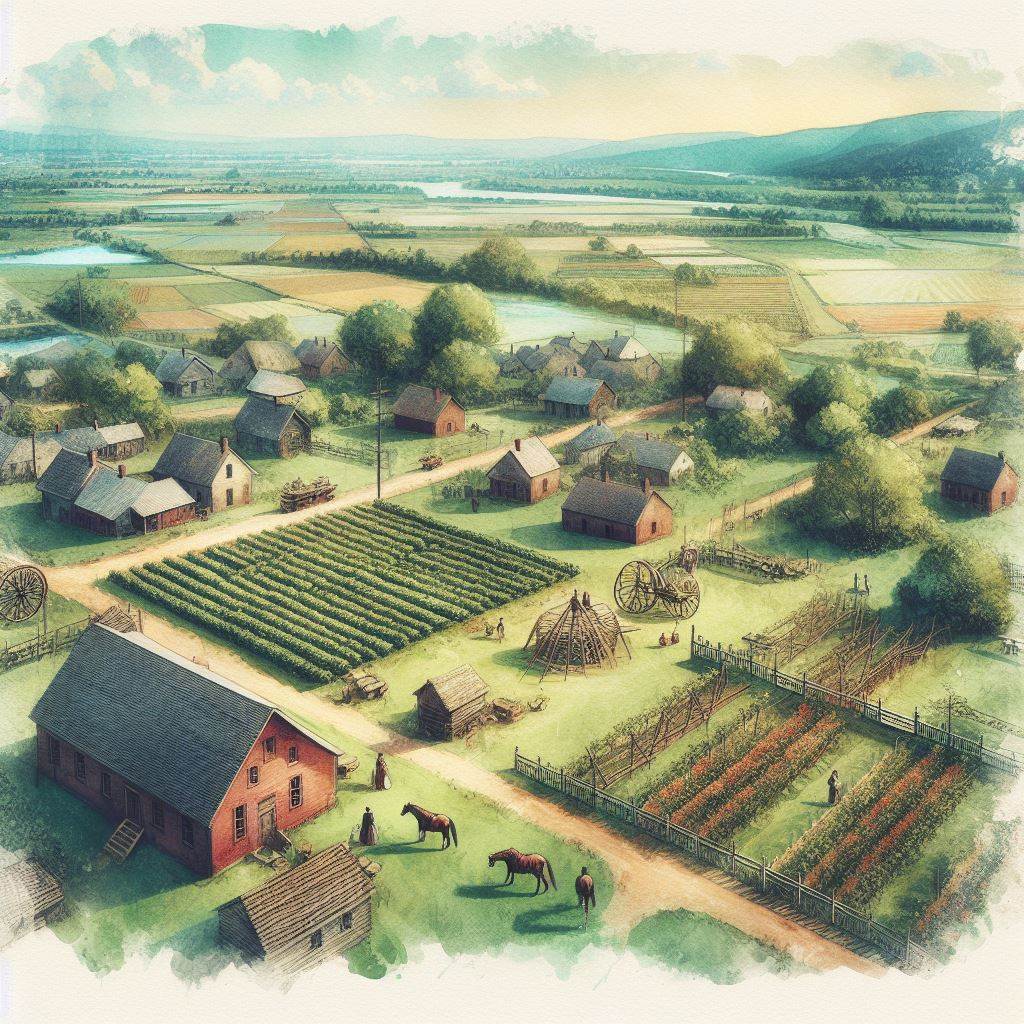
Edmund Morris’ book Ten Acres Enough: The Classic 1864 Guide to Independent Farming presents a unique view into the life of an ordinary man, who like many today, dreamt of moving to the country as a small time farmer. Morris describes how he in his mid 40s purchased just ten acres in rural New Jersey upon which he would build a better life for his family. Morris takes the reader on a year-by-year journey through how he built a successful small farm while portraying their daily life and how it contrasted that of their previous urban existence.
Many today look to the famous and the wealthy for life advice and societal direction, naively assuming that monetary success is synonymous with “life success” and wisdom. I think, instead, Ed Morris is a model of a successful man: one who had a humble goal for his life and achieved it.
A Gift for Thrift
A prime takeaway from reading the book is one of extreme economy, or the prudent use of money. Morris recounts how a neighboring German farmer bought a dilapidated eight acres, and with only $3 remaining and much labor, cultivated it into not only a profitable farm, but also into a comfortable home for his family. Morris wrote:
“He began with four pigs, which he paid for in work. The manure from these was daily emptied into an empty butter-firkin, which also served as a family water-closet, and the whole was converted into liquid manure, which was supplied to cabbages and onions…Long before winter set in, this hero had bought a cow, for while his own crops were growing he had earned money by working around the neighborhood. He readily obtained credit at the store, for he was soon discovered to be deserving… His cabbages and roots discharged his little store-bills, and kept his cow during the winter, while the living cow and the dead pigs kept the entire family, for they lived about as close to the wind as possible…. As it was seven years from his beginning when I first became acquainted with him, his little farm bore no resemblance to its condition when he took possession. There were signs of thrift all over it. His fences were new, and clear of hedge-rows; his house had been completely renovated; he had built a large barn and cattle-sheds, while his garden was immeasurably better than mine. Every thing was in a condition exceeding all that I had seen elsewhere… All this time he had continued to enlarge his means of manufacturing and applying liquid manure, as upon its use he placed his main dependence… This man’s great success in a small way could not have been achieved without the most assiduous husbanding of manure…The increase of his manure heap was so great that his little farm was soon brought into the highest possible condition…“
The key to this industrious farmer’s success was his tenacious tending of manure, the lifeblood of his crops, but more importantly in his ability grow his few dollars into a working farm.
Today we know very little of true economy; our sense of being prudent with funds usually only goes so far as limiting how often we eat at restaurants, simply buying cheaper but less quality items, or canceling a few extraneous subscriptions. Few today are capable of obtaining goods and services without buying them outright.
We buy an inordinate amount of things. Doing the math, dollar-for-dollar adjusted for inflation (about a 26:1 ratio in current USD to the USD in 1850), hand tools cost about the same. Throughout the book, in fact, I find many things apparently cheaper for Ed Morris than for us today. The difference, of course, is that Ed Morris wasn’t making nearly as many dollars, even adjusted for inflation. So why then do we consider ourselves wealthy comparatively? We simply buy more things. For Ed Morris, there were no TVs, cars, LED lightbulbs, modern toilets, phones, plastic toys, electric mixers, microwaves, tractors, AA batteries, ziploc bags, ad infinitum. We make more money on average, but we just as soon spend it on thousands of products that did not exist in Morris’ time. The truth is, we don’t need any of those things to survive. We are afraid of being without these conveniences.
Hands in the Dirt
Such prudence in funds requires a family with patience for discomfort. Morris’ wife and children went without many of the luxuries they had in the city for some time, until the prosperous farm brought enough income for items beyond necessity. Even after a positive income was acquired, Morris wrote that still they would not describe their new life as “comfortable” in comparison to their city life. Such a willingness to voluntarily submit to discomforts is a sign of great humility, as it acknowledges that man, like Adam banished from the Garden of Eden, was not meant for a life without toil.
One of Morris’ finest qualities was his humility in learning from others. In winters, he spent time visiting the neighboring farms and learning (sometime adopting and sometimes rejecting) their methods. Though he was not one to blindly follow the methods of his more senior neighbors, he found many instances where his neighbor’s productivity, even on smaller acreages than his own, exceeded his productivity. From these farmers, Morris was ready to learn in order to better himself.
Throwing the Dice
Morris exhibited an extraordinary courage that few match in their lifetimes. The idea of mustering up our current cash and dumping it nearly entirely into a new venture and lifestyle that has a reasonable chance of failure – to the detriment of the entire family – seems absurd to most. Though sometimes such gambles are motivated by stupidity rather than courage, the success executed by Morris in beginning this farm make it clear his motivations were founded in the latter. Few today would be willing to give up financial safety for the chance at what appears to be a happier lifestyle, especially when it involves risking the support of a large family. Today, we are usually concerned so acutely with what our retirement accounts will look like, how we will afford various insurances and current luxuries, and how we could ever imagine making less income than we currently make. A voluntary financial “step backwards” is difficult for the modern man to comprehend.
Another instance of Morris’ courage, or at least of his confidence, is in his farming practices. Though a new farmer, he held a contrarian concept of weeding from his neighboring farmers, who thought it pointless to remove weeds seeing as they would inevitably grow back. Instead, Ed Morris spent years tediously removing weeds in the hope that future years would steadily improve and did not receive any justification for his methods until about four years in. The pervasive common sense of the day was that one could never really get rid of the weeds. Morris, however, went to extraordinary efforts to remove every weed possible. His efforts eventually paid dividends in reduced weed loads in later years and better production and profits.
Conclusions
Ed Morris is an example of someone who had a dream, jumped out on a limb, and with prudence and determination achieved that dream. Anyone interested in homesteading or operating a small farm will find his work Ten Acres Enough an enjoyable and inspiring read. It’s also a great way to learn about history through the lens of a small farmer during the mid-19 century America.
 Born for the Barn
Sounds like a great book, a worthy read. You said so much that is true of us in this current day and age. Living with intention, purpose and vision apart from what the world dictates is not for the faint of heart. I am a Granny now 🙂 so I have a lot of years behind me. I wish the best for you and your family. I enjoyed your post.
LikeLiked by 1 person
Thanks Mitzy!
LikeLike